“The best way to solve problems and to fight against war is through dialogue.”
“The reality today is that we are all interdependent and have to co-exist on this small planet. Therefore, the only sensible and intelligent way of resolving differences and clashes of interests, whether between individuals or nations, is through dialogue.”
This past weekend I had the privilege of introducing Aziz Abu Sarah and Maoz Inon, authors of The Future is Peace, at the National Writers Series in Traverse City. Here’s a brief story of how that came to be.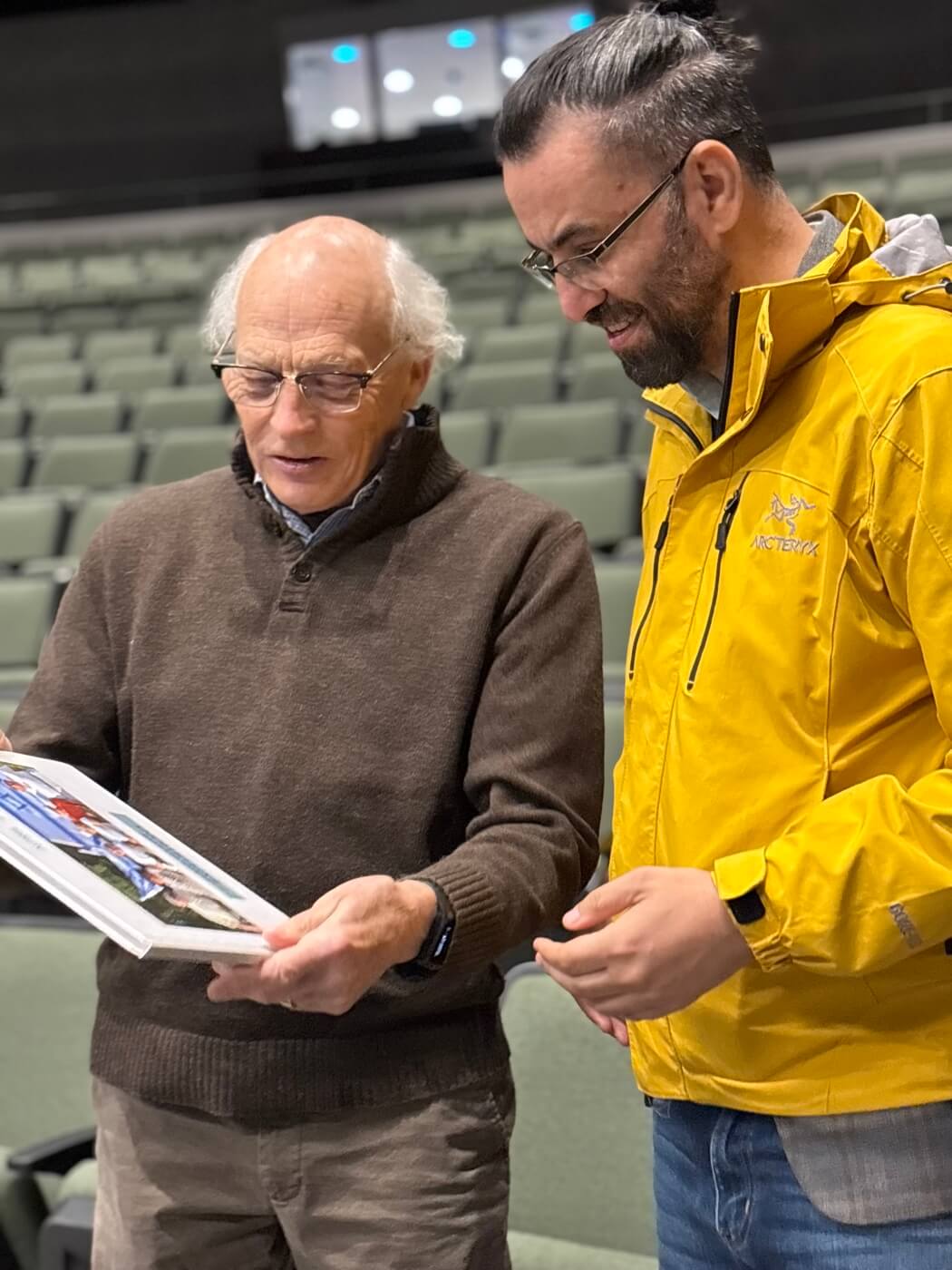
My wife and I started a book group 42 years ago in Basking Ridge, NJ. Our first book was 1984 by George Orwell. How strange that life looks more like 1984 now than it did then.
After meeting monthly for almost 30 years, our book group read the Lemon Tree by Sandy Talon. The book tells the story of a Palestinian person who abandoned his home in 1948 during the Nakba (or War for Independence, according to the Israeli perspective) and returns 19 years later to meet the Jewish person living in the home he had to leave behind. The book not only provides a broad and detailed context for the current wars in the Middle East but also humanizes the experiences on all sides and inspires a path for peaceful outcomes. If you haven’t read it, I highly recommend it.
As a result of that discussion, the book group decided we needed to learn more about the Israeli/Palestinian situation, so we “booked” a tour in 2013 with Mejdi tours. As it turned out, Aziz was our guide. We were able to visit Jerusalem, Nazareth, Bethlehem, Tel Aviv, Jericho, and the Dead Sea. We met with Imams, Holocaust survivors, and Christian theologians. It was a life changing experience.
Three highlights stand out. First, Aziz arranged for us to meet his parents at their home in Palestine. They served us the most delicious dinner, we shared stories, listened to music and even danced together In their home. Christians, Jews, and Muslims broke bread together – peacefully.
Second, we visited Jerusalem which houses the most sacred places for Jews, Muslims, and Christians: The Dome of the Rock, the Al-Aqsa Mosque, the Holy Sepulcher, and the Wailing Wall. People from all three religions prayed together in close proximity – peacefully, for the most part.
Third, we met with a senior leader of the PLO in the West Bank to learn about the Palestinian perspective on occupation. We heard and shared multiple points of view and competing narratives – peacefully.
What was truly life-changing for all of us was watching Aziz, a Palestinian; Yuval, an Israeli Jew; and various Christian authorities at different points of the tour engage in meaningful conversation. As you can imagine, this cast of characters had strongly held and opposing opinions – and they expressed them openly, honestly, and directly. The underlying tone, however, was respectful, and the messages were delivered civilly. Each person listened carefully to the “other” and genuinely attempted to understand their points of view. What we witnessed was productive dialogue powered by love.
When I shared with Doug and Anne Stanton, the co-founders of the National Writers Series, that I had a connection to Aziz, they asked me to introduce him. The event was held in the Traverse City West auditorium. Nearly 300 people attended, with another 160 people watching online. The audience was attentive and appreciative as Aziz and Maoz shared their stories. At age 10, Aziz lost a brother who was captured and beaten by Israeli forces and then died from injuries suffered in jail soon after his release. More recently, Maoz lost his parents, many relatives, and close friends in the October 7 massacre of 1,200 Israelis by Hamas.
Aziz, who had briefly met Maoz 13 years earlier, reached out to him the day after the atrocity. Surprisingly, Maoz returned his call. Now, they are touring the world as brothers, imploring people to find another path. As Maoz said, we are placing an anchor in the future and pulling ourselves to peace instead of planting our anchor in the past and being constantly dragged into war. It’s a story that needs to be told broadly. I can’t recommend their book strongly enough.
During the interview with Aziz and Maoz, Ed Ronco, the Interlochen Public Radio News Director, asked how it is possible to reconcile differences in spite of such deep and long divides. Maoz said it starts with forgiveness. That essential step only requires one person to decide to let go of the hate that brings everyone down. Aziz followed up by saying that reconciliation is more difficult because it requires both parties to choose a different path. In short, everyone has the agency to forgive, AND it requires collective action to reconcile.
In the Q&A session after the interview, one audience member asked, “How can we reach a two-state solution when neither party seems to be able to agree what that might look like, and some are adamantly opposed to it?” Aziz replied, “It’s not about the options, it’s about the values.” To Aziz, it doesn’t matter if the solution is one state, two states, or a confederation. What matters is that all parties agree on the importance of shared values, e.g. Equality, Dignity, Inclusiveness, Decency, Justice, Peace and Security. If all parties focused on a set of shared values instead of oppositional options, then it might be possible to find common ground and solve the problems plaguing all participants for thousands of years. Sounds right to me.

My main takeaway from the event was the need to amplify the voices of the peacemakers instead of the warmongers. Aziz and Maoz are showing us that the path to peace is peace. If their heart wrenching story does not make that simple maxim true, I don’t know what will. We all have a role to play in that transformation in our daily lives. We have to hang onto the belief that change is possible.
I’m a big fan of the National Writers Series because it is doing exactly what Aziz and Maoz are proposing. They are amplifying voices. They are engaging people in meaningful dialogue. They are encouraging all of us to become more deeply informed. They are teaching kids to read and write – to engage in a “Battle of the Books” instead of a battle of bullies, bombs, and bullets.
As for our book group, we are still meeting after 42 years. The next book on our docket: The Future is Peace.
I’m hoping Aziz and Maoz can inspire more people to find a peaceful path to peace. I’m hoping leaders around the world can engage in productive dialogue powered by love. And I’m hoping every book group chooses The Future is Peace as their next book. May it be so.